

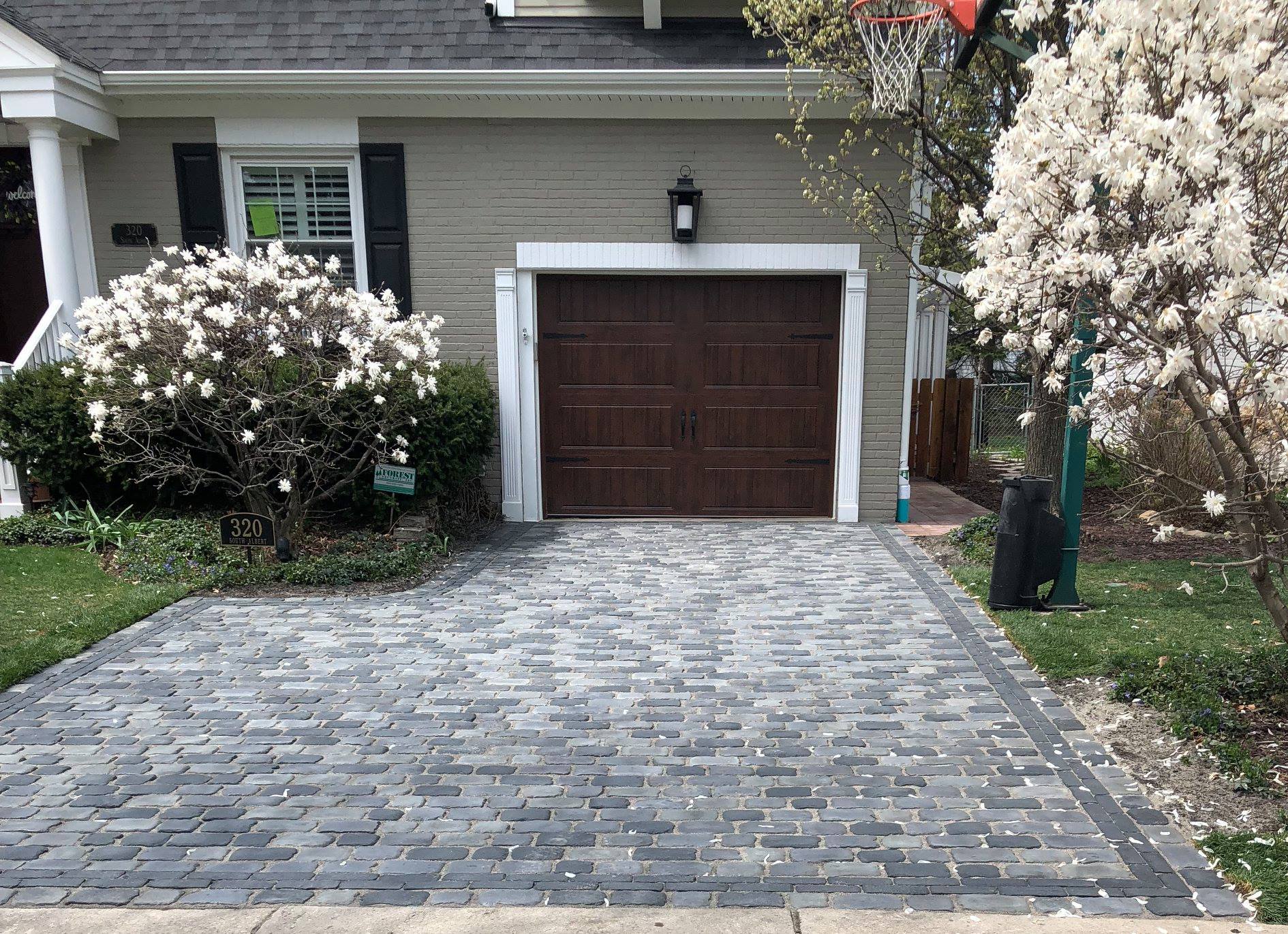
A brick paver driveway in the Chicago suburbs is the most expensive of the three common driveway materials to install. Concrete lands in the middle, and asphalt is the cheapest to put down. Tearing out an old driveway adds to the total no matter which material you pick.
Upfront price is what most homeowners walk in with, and it’s also what causes the most second-guessing. The cheapest driveway on the day it’s finished is rarely the cheapest driveway in year twenty, and our winters have a way of sorting that out. Here’s how the three materials really compare once you account for freeze-thaw, road salt, and what happens the first time a section gives out.
| Factor | Brick Pavers | Concrete | Asphalt |
|---|---|---|---|
| Upfront installed cost | Highest of the three | Mid-range (plain), higher for decorative | Lowest of the three |
| Expected lifespan | 25-50+ years | 25-40 years | 15-20 years |
| Ongoing maintenance | Sealing every few years, occasional re-set | Optional sealing, crack repair | Sealcoating every 3-5 years |
| Repairing one bad section | Lift and reset the affected pavers | Patch is visible, or replace the slab | Patch, then the patch shows |
| Design options | Hundreds of colors, shapes, and patterns | Gray, or pay decorative pricing | Black |
Why the Chicago Climate Affects the Cost
Anywhere else you could compare driveway materials on price and appearance and call it a day. Around here, the ground won’t let you. The Chicago area sees dozens of freeze-thaw cycles every winter, and each one puts stress on your driveway. Water works its way into the surface, freezes, and expands, pushing the material upward before settling again when temperatures rise. Add road salt and our clay-heavy soil, which expands and shifts with changing moisture levels, and it’s clear that what sits underneath your driveway matters just as much as what you see on top.
That’s why local prices sit at the higher end of the national ranges you’ll find online. A driveway built for this climate needs 6 to 8 inches of compacted base, not the 4 inches that’s fine in Georgia. Any quote that skips it is cheaper for a reason.
The real difference between the three materials is what happens when the ground shifts. Concrete and asphalt are one continuous surface, so movement has to go somewhere, and it usually goes into a crack. A brick paver driveway is thousands of separate units on a flexible base with sand in the joints. It absorbs the movement instead of fighting it.
What You’re Paying for in a Paver Driveway Quote
The pavers themselves are usually the smaller half of the invoice. Material costs vary widely depending on whether you choose concrete pavers, clay brick, or natural stone slabs. The rest is work nobody sees once the job is done:
- Excavating and hauling away the old driveway and soil
- Grading so water runs away from your garage and foundation
- Geotextile fabric between soil and gravel
- Compacted gravel base, in lifts, 6 to 8 inches deep
- Bedding sand and screeding
- Cutting pavers to fit curves, aprons, and edges
- Edge restraints, which keep the perimeter from spreading
- Polymeric sand swept into the joints, then final compaction
That list is why two paver quotes for the same driveway can be so far apart. One contractor is pricing the base, and one is pricing the pavers. Make sure to ask for an itemized estimate.
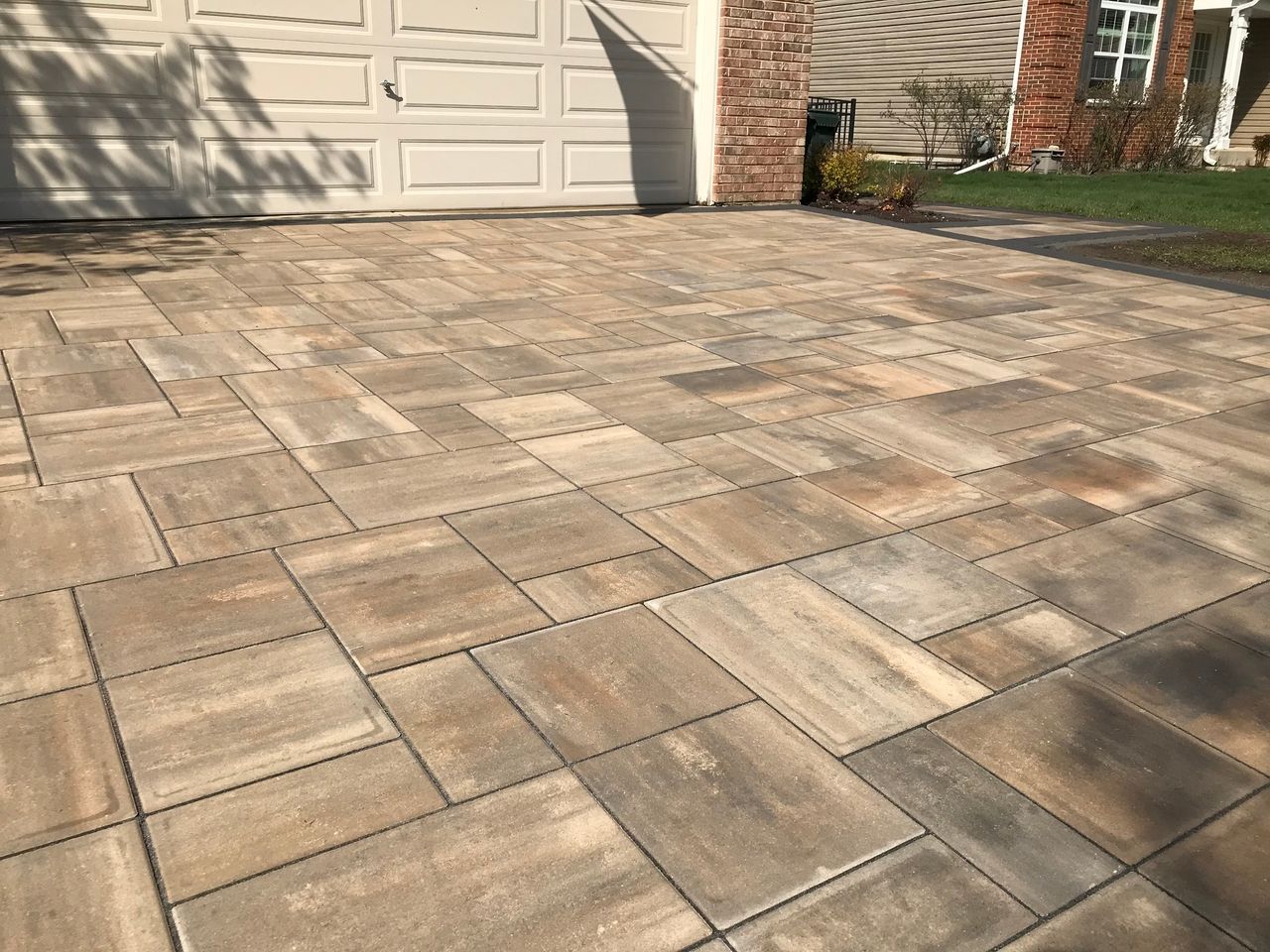
Asphalt: Cheapest Today, Priciest to Keep
Asphalt wins the upfront comparison. It’s the least expensive of the three to install on a two-car driveway, and the crew is usually in and out in a day or two.
The catch is the maintenance calendar. Asphalt needs sealcoating every three to five years, and skipping it shortens the driveway’s life considerably. Even on schedule, most asphalt driveways here need replacing at 15 to 20 years. Salt and freeze-thaw are hard on it, and hot July afternoons soften the surface enough that a trailer jack leaves a dent. Over 30 years you’re paying for one installation, roughly eight sealcoats, and a full replacement somewhere in the middle.
Concrete: The Middle Option, With One Chicago-Specific Problem
Plain gray concrete is a reasonable value, and a properly poured slab on a well-compacted base will give you 25 to 40 years with light maintenance. If your priority is a functional driveway at a moderate price, concrete is a defensible choice.
Two things trip up homeowners. Decorative concrete gets expensive fast, as stamped, colored, or exposed-aggregate finishes can push you into paver territory while still leaving you with a slab.
The bigger issue is cracking. Control joints help direct where it happens, but frost heave and shifting clay eventually win, and a concrete patch never matches the surrounding slab. Once cracking spreads, the fix is replacing whole sections or the whole driveway. You can’t repair 40 square feet of concrete and have it look like nothing happened.
Brick Pavers: Highest Upfront, Easiest to Live With
A brick paver driveway is the biggest check of the three. It’s also the one that ages best here, and the reason is repairability. If a section settles or an oil leak stains it, we lift those pavers, correct the base underneath, and put them back. Same pavers, same color, no seam. A cracked paver gets replaced individually. Nothing about that work announces itself afterward, which is not true of a concrete patch or an asphalt repair.
Interlocking pavers handle vehicle loads well, flex with freeze-thaw movement, and shrug off road salt better than a poured surface. Properly installed, a paver driveway lasts 25 to 50 years or more, and industry data puts the resale return around 69 percent.
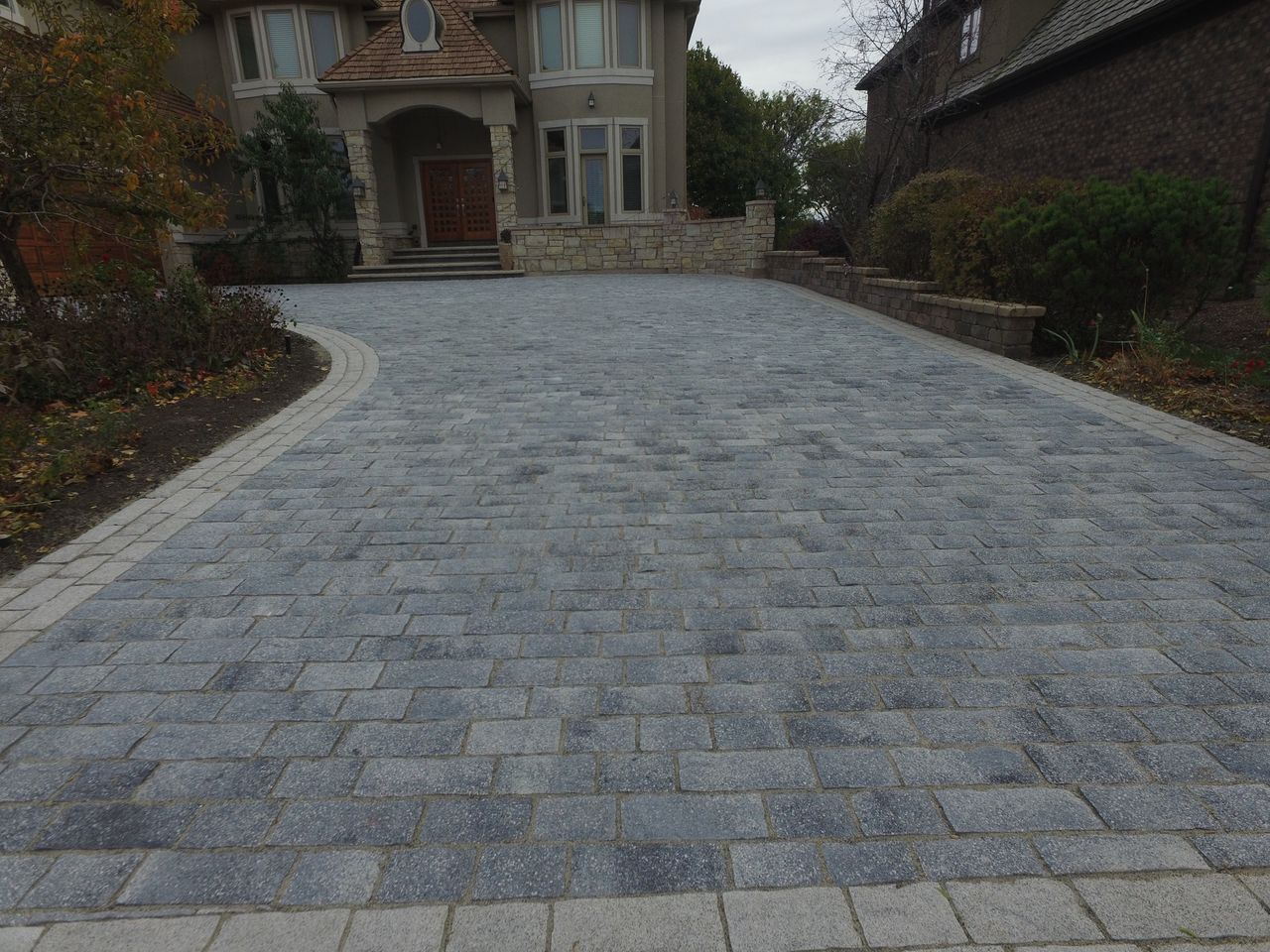
The design range is the other thing you’re buying. We carry Unilock pavers and natural stone slabs in a wide range of shapes, colors, and textures, laid in whatever pattern suits your home. Ask about permeable pavers too, since they let stormwater drain into the soil instead of running toward the street.
The Long-Term Comparison Nobody Runs
Take a 600-square-foot driveway over 30 years. Asphalt needs a full replacement inside that window plus about eight sealcoats along the way. Concrete usually makes it with light maintenance and a repair or two. Pavers are still in service at year 30 with some sealing and maybe a re-set.
Concrete is the cost-per-year winner on paper, but that math assumes the slab behaves for three decades, which is the assumption our winters most often break. What the paver premium buys is a driveway that can be fixed instead of replaced, and one that still looks like the driveway you paid for in year 25.
Getting Quotes You Can Compare
Ask every contractor the same four questions:
- How deep is the compacted base?
- Is edge restraint included?
- Is old driveway removal and disposal in the price, or extra?
- What does the warranty cover, and for how long?
If one bid comes in dramatically lower, one of those four answers is usually the reason.
Talk to a Certified Brick Paver Driveway Contractor
Pavestone Brick Paving, Inc. installs brick paver driveways in Des Plaines and the surrounding north and northwest Chicago suburbs, and we’re an ICPI certified Unilock and Rochester Authorized Contractor. Before any work begins, we’ll build a 3D digital model of your driveway so you can see the pavers, colors, and pattern in full color and adjust the design until it’s right.
To learn more about our brick paver driveway installation services, call us at (847) 895-7004 for a free estimate, or browse our driveway gallery for recent projects.
Brick Paver Driveway Cost FAQs
How much does a brick paver driveway cost in the Chicago suburbs?
Cost depends on the size and shape of the driveway, the paver or stone you choose, and how much excavation, base work, and drainage the site needs. Chicago-area pricing sits at the upper end of national ranges because our freeze-thaw climate requires a deeper compacted base, and removing an existing driveway adds to the total. An itemized on-site estimate is the only way to get an accurate number.
Are paver driveways worth the extra cost over concrete?
It depends on what you want from the driveway. Concrete costs less per year on paper. Pavers can be repaired invisibly, flex with freeze-thaw movement instead of cracking, offer far more design options, and return roughly 69 percent of their cost at resale. If you plan to stay in the home, the premium is easier to justify.
How long does a brick paver driveway last in Illinois?
A properly installed paver driveway lasts 25 to 50 years or more. Because individual pavers can be replaced and settled sections lifted and re-set, the surface never hits a hard end-of-life the way asphalt does at 15 to 20 years.
Is asphalt cheaper than pavers in the long run?
No. Asphalt is the cheapest to install and the most expensive to own. Sealcoating every three to five years is a recurring expense, and most asphalt driveways here need full replacement within 15 to 20 years. Over 30 years, asphalt often costs close to what pavers cost while looking worse for most of that period.
Can pavers be installed over an existing concrete driveway?
Sometimes, but it isn’t the default. A paver driveway needs a properly graded and compacted base to carry vehicle loads, and a slab that’s cracked, heaved, or poorly drained won’t provide one. We evaluate the existing surface during the estimate and recommend removal when it can’t support a lasting installation.
Do brick paver driveways handle road salt and snow plowing?
Yes. Interlocking pavers hold up well against de-icing salt, and the flexible joints absorb the freeze-thaw movement that cracks poured surfaces. Sealing helps resist staining. When plowing, keep the blade slightly raised and use a plastic-edged blade or shovel to avoid chipping paver edges.